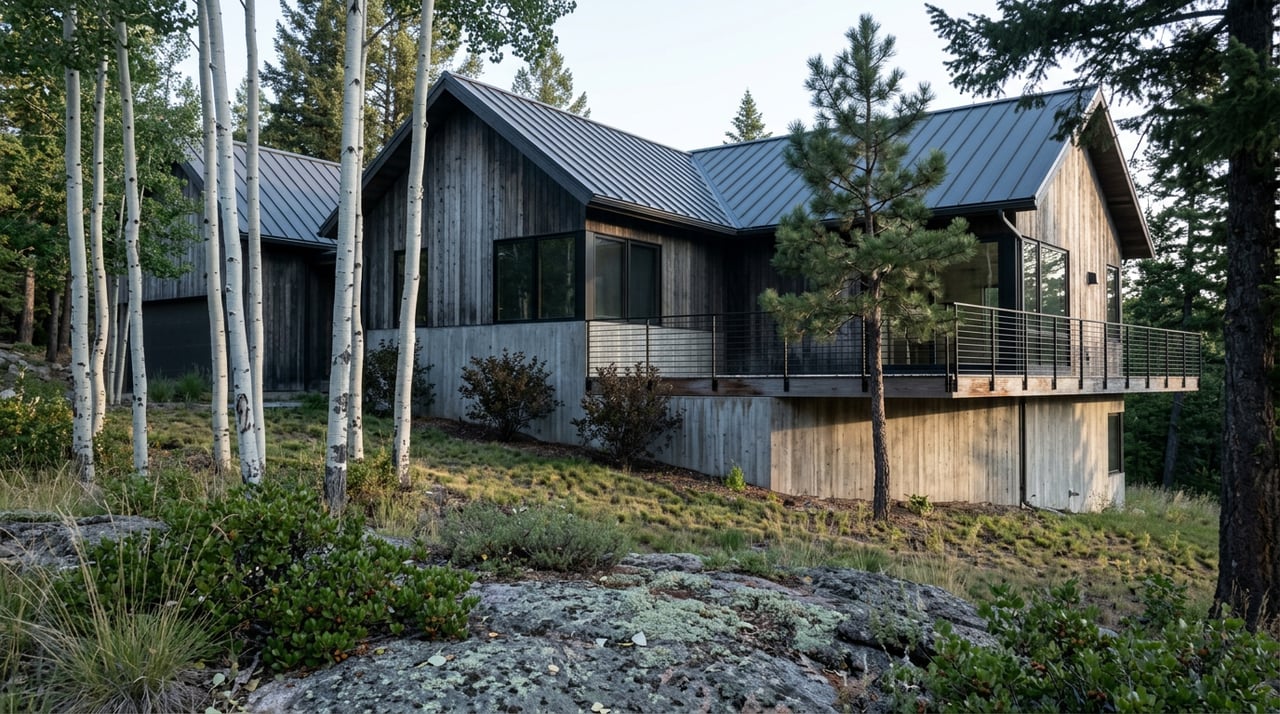
Orville Strain has lived in Evergreen for fifty years. When Denver7 asked him this summer whether he felt fully covered if his home burned, he didn't hedge. "Probably not. Not 100%, no." He's not alone in that math, and he's not wrong to worry about it. Strain has done mitigation work on his property, the kind insurers say they want to see, and he still isn't sure it's registering with the company that writes his policy.
That uncertainty just became a legal question with a legal answer. Under HB 25-1182, as of July 1, 2026, Colorado insurers who use a wildfire risk model to underwrite, price, or decline a homeowners policy have to tell you the score they assigned your property, the range of scores possible, and which features of your house pushed you toward one end or the other. If you disagree, you can appeal it. If your mitigation work isn't already built into the model, the insurer has to give you a manual discount for proving it.
For anyone comparing homes in Evergreen right now, this changes what the median sale price is actually telling you.
The Number That Was Always There, Just Invisible
Evergreen's home values have been reported differently depending on who's counting. Movoto put the July 2026 median sale price at $1,040,000. Redfin's three-month window ending June 2026 showed a median of $888,000, with price per square foot up 4.7% year over year to $378. Neither number is wrong. They're measuring slightly different pools of sales over slightly different windows, which is normal and worth reading as parallel signals rather than a single fixed truth.
What neither number includes is the second bill that arrives after closing: the homeowners insurance premium. And in Evergreen, that bill has stopped tracking neatly with home price. It tracks with wildfire risk, and wildfire risk in Evergreen isn't uniform street to street.
House Bill 25-1182, signed by Governor Polis in May 2025, is Colorado's answer to a problem homeowners have been living with since the Marshall Fire reshaped the state's insurance market. Representative Brianna Titone, who represents Arvada, put the intent plainly:
"Coloradans have invested in wildfire mitigation efforts on their property before, only to receive no discounts from their insurance companies. Our law, going into effect next month, requires property insurance transparency and accountability so Coloradans know what insurers expect and can effectively lower their rates."
That accountability is new. Before this year, a homeowner could spend thousands clearing defensible space and never know if it moved the needle. Now the insurer has to show its work.
Same Town, Different Risk
Evergreen isn't one insurance market. It's several, layered by terrain and access, and the risk data makes that easy to see once you look for it.
Kittredge, tucked into Bear Creek Canyon on Evergreen's south side, sits at the sharp end of that spectrum. Every property in Kittredge carries some degree of wildfire exposure, and nearly a third face what's classified as extreme flood risk from the creek that gives the canyon its name. Bergen Park, by contrast, sits in the flatter, more open stretch near the Evergreen Parkway interchange, and local insurance agencies that write policies across Jefferson County describe it as one of the quieter, lower-rate pockets of the mountain communities they serve.
| Factor | Kittredge | Bergen Park |
|---|---|---|
| Wildfire exposure | All properties carry some level of risk | Comparatively lower-rated locally |
| Flood exposure | Nearly a third rated extreme, tied to Bear Creek | Not flagged as a primary concern |
| Terrain | Steep canyon, limited access roads | Flatter, closer to Evergreen Parkway |
| Insurer framing | Often requires fire zone coverage | Described by local agencies as a lower-rate area |
None of this shows up in a listing photo. A buyer comparing two homes at similar price points in these two areas could get quotes that differ by thousands of dollars a year, and until this year, they'd have no way to know why beyond a vague sense that "mountain insurance is expensive."
What the Backstop Actually Costs
When a private carrier won't write a policy, Colorado's FAIR Plan is the fallback, and it's useful for showing what full wildfire exposure costs in real numbers. A 2,288 square foot home in Evergreen valued at $850,000 runs about $4,361 a year for basic FAIR Plan fire coverage, plus another $1,151 for wind and hail. That's north of $5,500 a year for coverage that's intentionally limited, and it's the plan of last resort, not the goal.
Private market premiums in Evergreen, Conifer, Morrison, Genesee, and Indian Hills have climbed from a pre-2021 range of roughly $2,200 to $3,400 a year to somewhere between $5,200 and $9,800 for the same coverage today, an increase in the range of 136% to 188% depending on the property. Statewide, Colorado homeowners now pay an average around $4,600 a year, roughly 58% higher than in 2018, and Colorado sits fourth highest in the country for average premium.
The gap between the FAIR Plan cost on one property and a private-market quote on another, both in Evergreen, both near the same price point, is the number a median sale price will never show you. It's also the number that can quietly change your monthly payment enough to affect what you qualify to borrow.
The Paperwork That Actually Moves a Score
Under the new law, mitigation only counts if it's documented in a way an underwriter recognizes. Two certifications carry real weight right now. Wildfire Partners, Boulder County's mitigation program, is already accepted by Allstate, State Farm for existing customers, and USAA as proof of hardening work. The IBHS Wildfire Prepared Home designation expanded into Colorado in April 2026, offering a base tier focused on ember resistance and a Plus tier covering radiant heat and flame exposure. Both programs check for the same underlying features: a Class A fire-rated roof, ember-resistant vents, and a cleared, noncombustible zone in the first several feet around the structure.
If you're building new or taking on a major renovation in Evergreen's wildland-urban interface, there's a second layer to know about. Colorado's statewide Wildfire Resiliency Code reached full enforcement on the same date HB25-1182 took effect, July 1, 2026, and it applies to new construction and renovations over 500 square feet in WUI zones. It doesn't touch existing homes with no qualifying work planned, but if you're weighing a fixer-upper against a comparable move-in ready home, the renovation math now includes code compliance you wouldn't have priced in a year ago.
Why the Clock Matters at Closing
The disclosure requirement isn't automatic on a set date for every homeowner. If you're buying a resale where the seller's policy won't transfer, you're starting from zero and need your own quote well before your financing contingency runs out, not after.
If you do want to appeal a score once you have it, Colorado Senate Democrats report that the insurer must acknowledge the appeal within 10 calendar days and issue a decision within 30. That's workable if you start early. It's a serious problem if you're trying to resolve it during a 30-day close, because the appeal window alone can eat the whole transaction timeline.
The practical move, whether you're comparing Kittredge against Bergen Park or a cabin along Upper Bear Creek against a newer build off Bergen Parkway, is to request an insurance quote at the same time you request a home inspection, not after. Ask what the seller's current premium is and whether it's likely to transfer. If mitigation work has been done, ask for the receipts and dated photos now, because that documentation is what turns a wildfire risk score from something you're told into something you can fight.
Does completing wildfire mitigation guarantee a lower premium? No. The law requires insurers to disclose your score and, if their model doesn't already account for mitigation, offer a manual discount for documented work. It doesn't set a required percentage, and a strong mitigation file improves your odds without guaranteeing an outcome.
What if the seller's insurance policy won't transfer to me? Treat that as a financing contingency, not an afterthought. Request your own quote as soon as you're under contract so you know your real monthly number before your loan commitment deadline, not after.
Evergreen's median price tells you what buyers paid in July 2026. It doesn't tell you what you'll pay every year after that, and for the first time, Colorado law gives you a way to see that second number before you're locked in. If you're weighing homes across Evergreen's neighborhoods and want a read on how a specific property's risk profile stacks up, House2Home Real Estate knows this terrain block by block. Reach out to Kimberly Tutor and our Arvada-based team to talk through what a listing actually costs to own, not just to buy.
This article is general information, not legal, tax or financial advice. Consult a qualified professional about your situation.